A little extra flour may seem harmless, and a generous splash of milk might look convenient. In baking, however, these small changes can alter how a mixture spreads, rises, and sets.
Accurate measurement helps preserve the balance built into a recipe. Understanding that balance—and knowing when to use measuring cups or a digital scale—makes results more consistent and mistakes easier to investigate.
1. Baking Depends on Ingredient Ratios
A baking recipe is a balance of ingredients with different jobs. Flour contributes structure, liquids hydrate dry ingredients, fats influence tenderness, and eggs help bind and set mixtures. Sugar affects sweetness as well as texture, moisture, and browning.
Changing one ingredient changes its relationship with the others.
Imagine a recipe calling for 200 grams of flour and 100 grams of water. Adding an accidental 40 grams of flour makes the mixture substantially drier, even though the water quantity remains correct.
Precision helps reproduce the balance the recipe developer intended.
2. Extra Flour Can Change the Whole Result
Flour is particularly easy to measure inconsistently by volume. A cup filled lightly can contain less flour than one pressed firmly into a bag.
Too much flour can contribute to dry cakes, crumbly cookies, or stiff dough. Too little may leave some mixtures without enough structure.
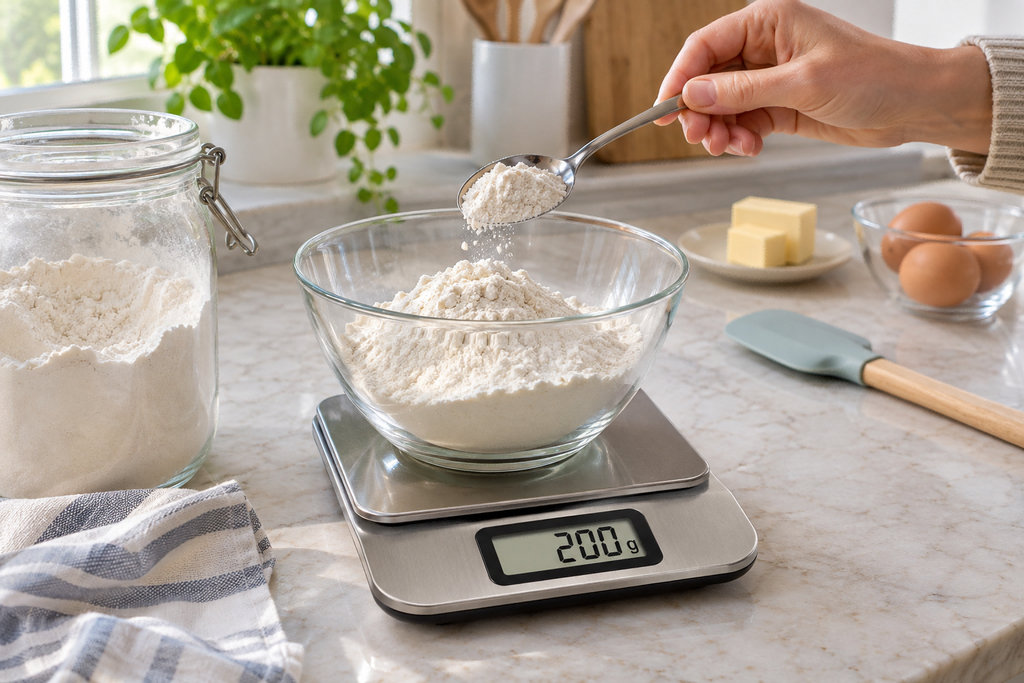
A scale removes the uncertainty caused by packing: 150 grams remains the same measured quantity whether the flour is fluffy or compacted. Follow the weight listed in your particular recipe.
3. Sugar and Fat Affect More Than Flavour
Sugar contributes to moisture retention, browning, and texture. Reducing it substantially can change how a cake feels or how a cookie spreads.
Fat also has several functions. In a creamed cake, butter helps incorporate air during mixing. In other recipes, melted butter or oil contributes tenderness through a different method.
Weighing the correct quantity is one part of success; using the specified ingredient in the specified condition matters too. Correctly measured melted butter cannot automatically replace softened butter in a creaming method.
For a first attempt, follow the recipe before experimenting with substitutions.
4. Small Quantities Can Have a Big Effect
Baking powder, baking soda, salt, and yeast are often used in small amounts, but errors can still affect flavour, rise, and structure.
A heaped teaspoon is different from a level teaspoon. Baking powder and baking soda are also different ingredients and should not be exchanged casually.
For quantities below your kitchen scale’s reliable measuring range, use proper measuring spoons when the recipe specifies them. A display that changes in one-gram increments does not guarantee accurate measurement of a tiny one-gram portion.
Precision means choosing a suitable tool for the quantity.
5. Measuring Cups Measure Volume; Scales Measure Mass
A measuring cup tells you how much space an ingredient occupies. A scale tells you its mass, commonly expressed in grams.
That distinction explains why one cup does not have a single universal gram equivalent.
| Tool | What it measures | Main consideration |
|---|---|---|
| Dry measuring cup | Volume | Packing and filling technique affect the amount |
| Liquid measuring jug | Volume | Read the correct line on a level surface |
| Digital scale | Mass | Check units, capacity, and measuring limits |
| Measuring spoon | Small volumes | Use the specified level or packed measure |
A cup of flour and a cup of sugar occupy the same nominal volume but have different weights. Conversions must match the ingredient.
6. Use Measuring Cups Consistently
You can bake successfully with cups when you follow the recipe’s measuring method.
For flour, use the technique recommended by the recipe developer. If it calls for spooning and levelling, loosen the flour, spoon it gently into a dry measuring cup, and level the top without compacting it.
For liquids, place a marked measuring jug on a flat surface and read it at eye level. Follow instructions such as “packed brown sugar” carefully.
Measuring conventions differ between recipe sources, so consistency with the original method matters.
7. Learn the Tare Function on Your Scale
Tare resets the display to zero, allowing you to exclude the bowl’s weight.
To weigh an ingredient:
- Place the scale on a firm, level surface.
- Select grams.
- Put your bowl on the platform.
- Press tare and check that the display reads zero.
- Add the ingredient slowly until you reach the required amount.
You can tare again before adding another ingredient. However, separate bowls are useful for ingredients that need different preparation or might be difficult to remove if you add too much.
Keep the scale within its maximum capacity, including the bowl.
8. Avoid Guessing Conversions
When a recipe provides both cups and grams, use its stated gram quantities rather than replacing them with values from another chart.
Recipe developers may use different measuring conventions. An ingredient chart is helpful when weights are absent, but the recipe’s own measurements take priority.
Do not assume millilitres and grams are interchangeable for every liquid. Oil, honey, and water have different densities. Similarly, a scale’s millilitre setting may rely on a preset density rather than directly measuring volume.
9. Use Accuracy to Make Learning Easier
Consistent measurement helps you understand your results. If your ingredient quantities remain steady, it becomes easier to assess other factors, such as mixing, pan size, and baking time.
Record useful observations after each bake. Note the recipe, ingredient weights, pan, and finished texture.
When scaling a recipe, multiply every ingredient by the same factor. Remember that a larger or smaller batch may also need a different pan and baking time.
Accurate weighing improves repeatability, but it works alongside careful technique and attention to the recipe.
10. Frequently Asked Questions
Do I need a scale to start baking?
No. Measuring cups and spoons can work well with suitable recipes and consistent technique. A scale makes many measurements easier to repeat.
Can I use an ordinary drinking cup?
Use a standard measuring cup. Drinking cups vary in capacity.
Should I weigh liquids?
Yes, when the recipe provides liquid quantities by weight. Otherwise, use the stated volume measurement or an appropriate ingredient-specific conversion.
Does every ingredient need a separate bowl?
No. Taring allows sequential weighing, but separate containers can make preparation and corrections easier.
Will precise weighing guarantee success?
It reduces one important source of variation. Ingredient condition, mixing, oven temperature, and doneness still affect the result.